Protestors attend Tel Aviv’s eighth annual SlutWalk
TEL AVIV, ISRAEL 一 Canada. Australia. South Korea. The United States. India. Brazil. Israel. Since 2011, thousands of protestors have marched down the streets of these countries and many more to participate in the SlutWalk, an international movement against rape culture and sexual assault. Tel Aviv, a liberal city located 46 miles away from Jerusalem, hosted its eighth annual SlutWalk on Friday, May 31.
Escorted by local police officers, the protestors trekked from Rabin Square to the end of Rothschild Boulevard, an iconic street in the heart of the city. Many of the protestors held signs concerning sexual assault, such as, “If she was asking for it, why couldn’t you?” and, “You don’t own me.” But despite chants of “No means no,” some bystanders watched the march with confusion as participants passed by in their undergarments.

“I’ve run into many people asking me questions and not knowing what it’s all about, all out of ignorance,” said Rotem Lutsky, who drove from a distant Kibbutz to attend the march in Tel Aviv. “It’s very exciting for me to bring awareness, and this is what this march does.”
The name of the march is intentionally provocative, achieving the goal to bring more awareness to its cause. The SlutWalk originated in 2011, when a campus safety forum in Toronto, Canada, became a national ordeal. The website for the SlutWalk in the United States says “a police officer told a crowd of college women that, if they wanted to avoid sexual assault, they shouldn’t dress like sluts.” This comment sparked a national outrage which rapidly spread across the world. 3,000 people attended Toronto’s first SlutWalk in 2011, and Tel Aviv held one the following year.
“I think it’s very important to speak up about rape culture,” said Lutsky, looking around as protestors marched around him. “We have a voice and a choice to use our voice for positive purposes or negative purposes. And fighting rape culture and gender equality, it’s a very positive influence.”
Amongst the crowds, there were also some protestors wearing yellow vests, indicating that they were organizers of the SlutWalk. Yarden Boytner, who is involved in feminist activism in Jerusalem, was one of these protestors. The day before the march, she protested against the return of former Dean and Professor David Newman, at Ben-Gurion University in Beersheba. Newman had been charged with allegations of sexual harassment. Along with the feminist non-governmental organization LUTAM, Boytner attended a welcoming day for potential students at the university. “We called people to come and sign petitions saying ‘I know that studying at this university might cause me sexual harassment.’” said Boytner. “So doing all of these provocative acts, it got on the news and on social media.”


Despite the achievements resulting from such provocative approaches, people living in Jerusalem are still pushing back against feminist movements. The 600 participants of this year’s SlutWalk in Jerusalem were called “prostitutes” as opposers to the march threw eggs at them. “Here, you can see someone in the street that you don’t know if they are from the march or just from Tel Aviv,” said Ieut Samhora, a schoolteacher from Tel Aviv, on the ways in which people dress less modestly. “In Jerusalem, you’re not used to seeing that, so it’s just a different environment.”
Organizers of the march in Jerusalem have noticed a decline in the number of participants due to the pushback by those in power. “One of the things that’s so horrible about men in positions of power is that a lot of them use religious arguments to put women away in social arenas,” said Boytner. “In Israel, it’s really prominent because we have strong Jewish, Orthodox, Ultra-Orthodox representation in the municipality of Jerusalem, in the government.”
Tel Aviv is a different story though. Marchers were encouraged to share their stories and to find solidarity. Loren Zekri has been coming to the march with her sister every year. But this year, when her sister could not attend, Zekri came with her friend and the words “My pussy, my choice” painted onto her stomach. Two years ago, Zekri was sexually assaulted, and received no mental or emotional help despite her efforts to find it. “In Israel we have a lot of sexism because of religious people. If you dress like this and go in the street they look at you and yell at you,” said Zekri, explaining why she was attending this year’s SlutWalk.
The fight for gender equality and against rape culture goes beyond blaming the Israeli government though. Boytner identified the required military service in Israel as a cause for why men in the country feel more empowered than women. From a young age, men are already being educated to become soldiers, said Boytner, who has already completed her service in the military after high school. “So already, in the first step of being an adult, you go into a frame that automatically gives men much more power, relevance and legitimacy to make decisions and influence reality.”
Haaretz, a daily, liberal newspaper based in Tel Aviv, identified that only 3 percent of women in 2012 served in combat positions in the Israeli Defense Forces. In 2016, the number raised to 7 percent due to demands for equality by feminist groups throughout the country.
While progress is slowly being made to integrate men and women in Israeli society, some Israelis are discouraged by international setbacks they have seen in recent media. Samhora has friends on FaceBook living in the United States, who have been discussing the strict changes to state abortion laws. Everytime Samhora said she is hopeful for the future of women, men seem to win again. “You feel hopeful and then reality just puts you back,” said Samhora.
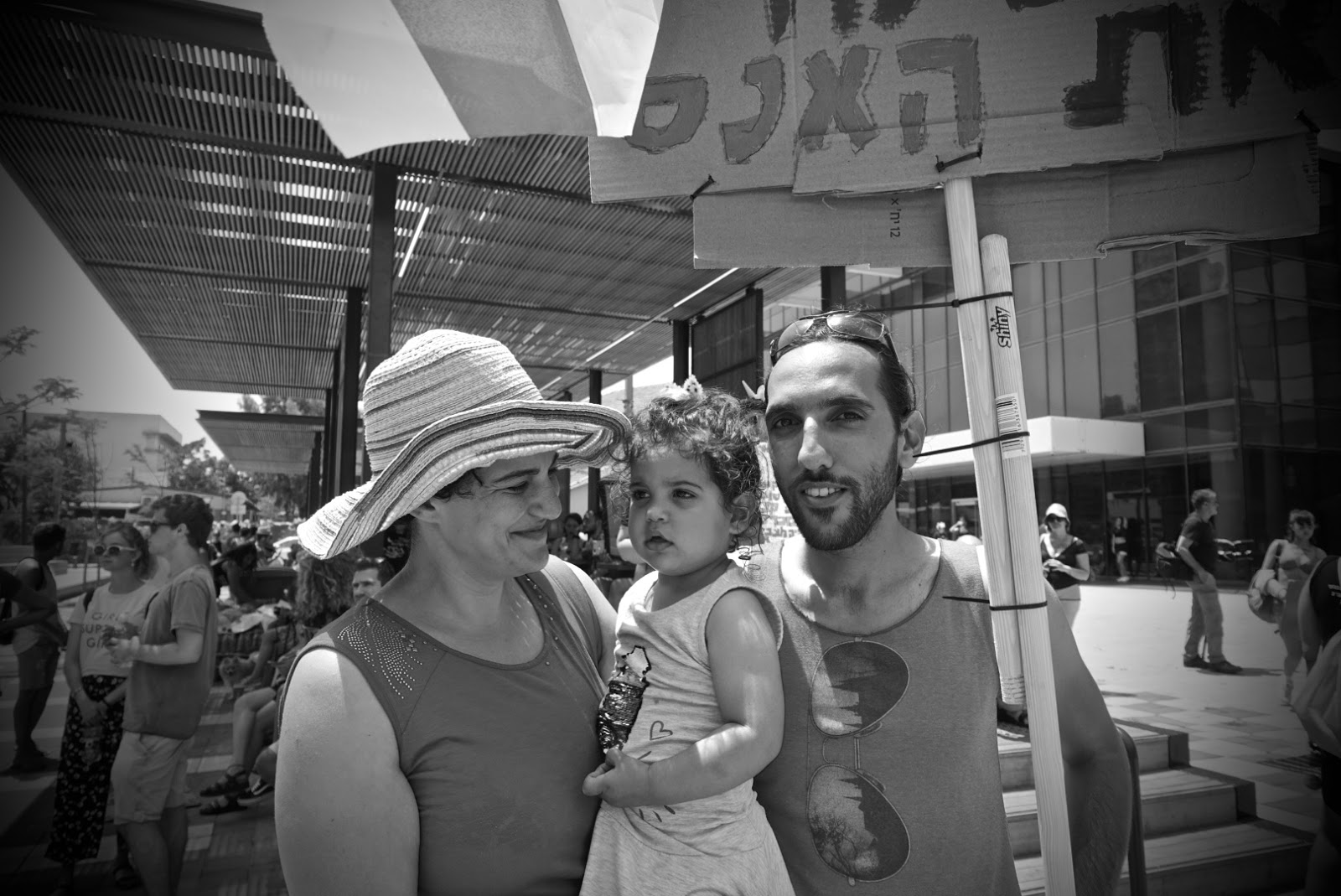
At the same time, being a teacher gives Samhora a sense of security for the future. “I think that the young generation has really changed,” she said. “I see how teenagers are becoming, and a lot of the boys as well, and I think from there the change will come.”
Along with her husband, Samhora pushed a stroller with their two-year-old daughter in it. The family was marching to give their daughter a voice in the future. “I’m not sure what will happen in a few years,” said Samhora. “But right now, I think it’s important for her to see so many people and to see the freedom, it will not make her misunderstand things.”
